
Siru
Kristull The Surprise
February 7, 1999 – April 4, 2016
Kristull Gringo X Kristull Kali
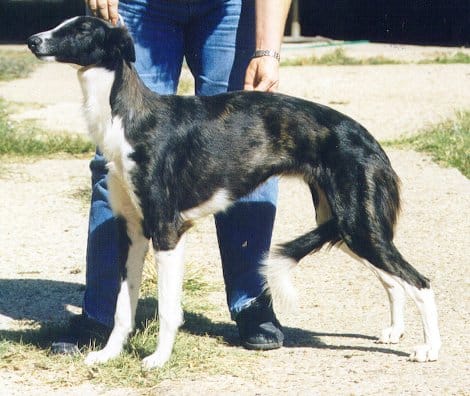
Siru had a litter here at Starcastle Hound’s but lived her long life loved by Salla.
Sirus full ownership was turned over to Salla after her litter here in Sweden.
Siru was one of the original Silken Swamphounds
Siru knocked me out
One day Francie put up photos of a hitherto unknown young girl.
Siru. And I just was – she has to go to Sweden! She has to!!!
Little did I know that Salla Klemetti, Kennel Sarafias in Finland had visited Francie in Texas the day before, and also fell in love with Siru.
Not sure how, but I ended up convincing Salla I should co-own Siru with her.
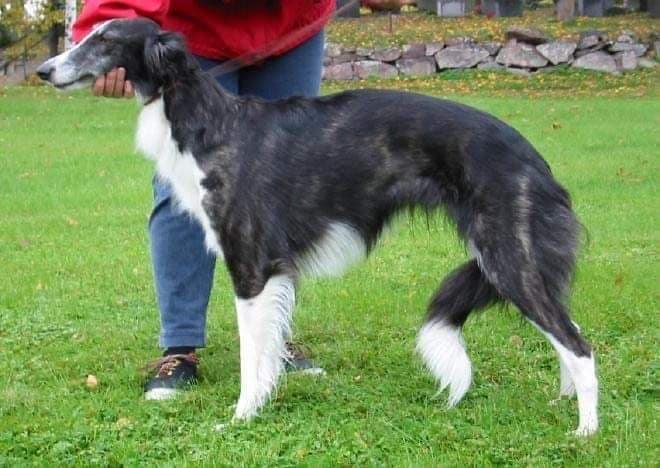
It was a joy to have Siru visiting here in Sweden for her litter.
I am forever grateful to Salla for making this possible.
Through her son Netscape she helped me steer my breeding program in a direction I wanted.
Siru lived a long life, 17 years, and so did her litter brother Teal’c in Finland.
Another litter brother back in USA lived to 16.
For me a litter with several pups that ends up living very long lives, that is a good thing. To me it indicates healthy dogs.
And this is something we should ALL be happy about, when we go on to study Sirus genetic impact on the breed.
Sweden
Sirus litter in Sweden consisted of 3 surviving boys, from a litter of 6.
This was unfortunately a lotus litter.
Only one of these boys went on to breed, Starcastle Hound’s Netscape, he sired one litter for me in 2002, 6 puppies, 3 of them were bred.
Let’s take a look at Netscapes grandfather curve and see the impact Sirus Swedish litter had on the gene pool
Grandfather curve of Starcastle Hound’s Netscape, offspring in first 4 generations, representing the Swedish and British (one daughter was exported to England) part of Sirus offspring
|
Generation 1 |
Generation 2 |
Generation 3 |
Generation 4 |
|---|---|---|---|
|
6 |
12 |
35 |
90 |
Finland
In Finland Siru had one litter with two daughters and a son. One of these daughters, Sarafias Cara was bred twice.
Let’s take a look at Caras grandfather curve and see the impact Sirus Finnish litter had on the gene pool
Grandfather curve of Sarafias Cara, offspring in first 4 generations, representing the Finnish part of Sirus offspring
|
Generation 1 |
Generation 2 |
Generation 3 |
Generation 4 |
|---|---|---|---|
|
10 |
15 |
15 |
20 |
But here is the kicker.
Siru had a litter in USA before coming to Europe.
6 puppies, 4 males, 2 females.
They were very young when Siru moved to Europe and none of us could foresee what happened next.
- Dante had 5 litters
- D’Arktagnan had one litter but that first litter did not breed on, it is a dead end in the population
- Dugal had 2 litters
- Dirk was never bred
- Dabisha had 5 litters
- Daiquiri had 4 litters
Grandfather curve of Kristull The Surprise, offspring in first 4 generations, representing all of Sirus offspring in the world for those 4 generations
|
Generation 1 |
Generation 2 |
Generation 3 |
Generation 4 |
|---|---|---|---|
|
11 |
85 |
300 |
1651 |

For those of you wondering how I could see so many in generation 4 now when the new online database is capped at showing 400 dogs maximum in the progeny function, it had no cap the first day it was up online…
And that is when I captured the figure for generation 4.
Do note that Siru was born in 1999 and this only shows the first 4 generations down from her. There are several generations more until this day, generations I can’t see because the online database will not let me.
Then keep in mind that the total amount of registered dogs in the database is around (hearsay…) 6000 dogs. And now it is time for when we should all gasp a little.
Siru was a wonderful dog, no doubt about it.
But no dog should put such a gigantic genetic footprint on a small numbered breed!

Sirus story is not about right or wrong decisions.
It reflects a time when the breed was still young, and knowledge was more limited than it is today.
It was also a time when there were very few dogs to breed from, and Siru and her siblings represented a new look — far removed from the proto-Silkens — the look that would come to shape the breed as we know it today.
It is no wonder that this line became so widely used.
What it does show, very clearly, is how quickly genetic influence can grow — even when it is not immediately visible in a pedigree.
We often associate the popular sire effect with males, but females can be just as influential — their impact simply tends to unfold over time, often through their male descendants across generations.
This is something worth keeping in mind when planning future breedings or imports.
What appears to be “new blood” may, in fact, already be closely connected within just a few generations.
Looking deeper into pedigrees is about understanding.
And understanding is what allows us to make better decisions for the breed going forward
.
|
Sirus Offspring in Sweden | |
|---|---|
|
Males |
Females |
|
| |
|
| |
|
| |
|
|
|
Susann Stjernborg
Silken Windhounds since 1998