
How long does a Silken Windhound live?
The life expectancy of the Silken Windhound is often described online as 17–20 years.
While individuals can reach this age, it is not typical for the breed as a whole.
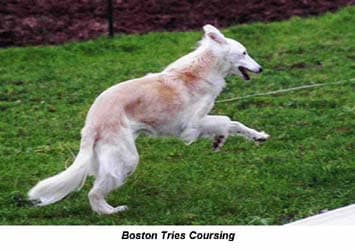
The record is held by Kristull Boston Legacy that lived a couple of months past her 20th birthday.
This is the iconic photo of Boston trying Lure Coursing for the first time in her life, she was 17 years old…
Some of Bostons kids lived to 18.
But let me clarify that Boston was not a full Silken Windhound!
She was a Founder, and she was purely LHW lines.
Her children, except one I think, were all F1, the fathers of these puppies were themselves F1 Silken Windhounds (or Projects as we call them).
But still, Boston was one of the Founders of Silken Windhounds and can be found far back in the pedigrees of many Silkens today.
Most Silken Windhounds live to around 12 years of age. Many reach 13–14 years, but fewer individuals live beyond 15. Ages of 16–17 years do occur, though they are relatively uncommon. Even more rare are the Silkens that made it to 18. Personally I can’t recall anyone at all that reached 19.
Skippy, Starcastle Hound’s Fire Faery, born 2004 — still happily running beside the bicycle at 15 years of age.
As in all breeds, lifespan is influenced by a combination of genetics, health, environment, and chance. Accidents and disease can affect dogs at any age, while age-related conditions become more common in later life. In older Silken Windhounds, it is not unusual to see reduced hearing and an increased incidence of cancers, which are common in aging dogs in general.
I have bred one Silken, Lizzie, that lived to celebrate her 17th birthday.
She had one daughter that lived to 16 and two granddaughters born here at Starcastle Hound’s also living to 16.
Unfortunately I do not have much information about lifespan and/or cause of death for descendants born at other kennels, in other countries.
In general, I have seen mostly lifespans around 14 years in my own breeding.
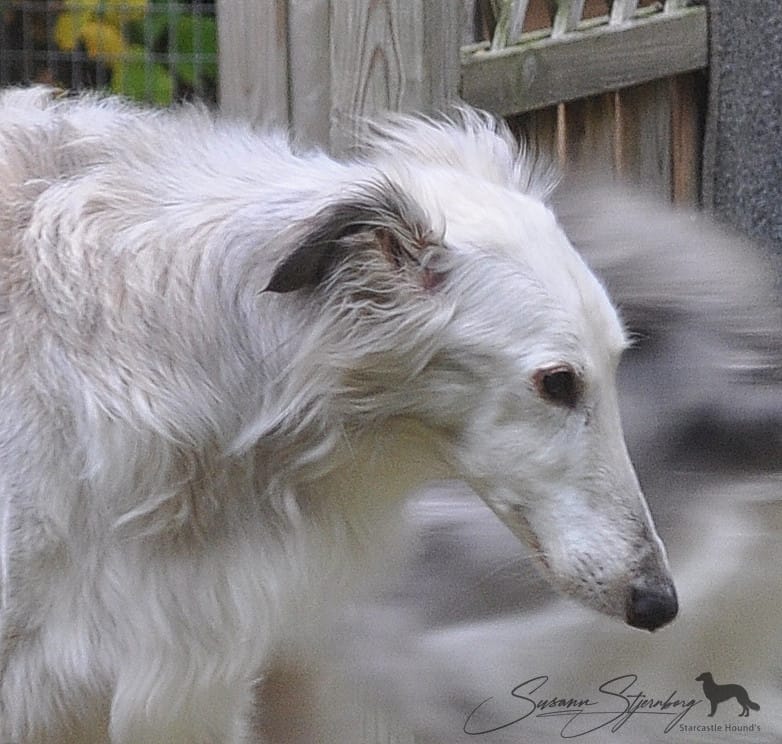
See more about the greying gene in Silken Windhounds.
Looking back in time, there are clear indications that longevity may cluster within certain families, where multiple related individuals reach higher ages. However, predicting lifespan through breeding remains difficult. By the time a dog proves to be exceptionally long-lived, it is usually already several generations removed from current breeding candidates.
For those interested in real-life examples of older Silken Windhounds, there is a long-standing Facebook group dedicated to individuals aged 13 years and older, where owners share experiences and follow their dogs over time.
Genetic diversity is generally considered beneficial for overall health and immune function, and may contribute positively to longevity. At the same time, there are examples within the breed of long-lived individuals with relatively high inbreeding coefficients, illustrating that the relationship between genetics and lifespan is complex and not yet fully understood.
Overall, the Silken Windhound can be described as a generally long-lived breed, with many individuals reaching a good age while maintaining quality of life
Did you find this information useful?

Every contribution helps preserve documents, photographs and first-hand accounts from the history of the Silken Windhound breed that might otherwise be lost.
Your support helps cover hosting, software, research and documentation expenses.
This website is privately maintained and funded.

Susann Stjernborg
Silken Windhounds since 1998